
As we know, treating acne requires a proper at-home skincare regimen, an understanding of our allergies and intolerances, and regular visits to an esthetician. A knowledgeable skin care professional will use a variety of professional products and modalities to deeply cleanse, exfoliate, de-congest, and disinfect the skin, as well as soothe and heal the inflammation associated with acne.
There is a myriad of different devices and modalities available to perform a service for acneic skin, but I will focus on a few of the most commonly used among skincare professionals, as well as explore Traditional Chinese Medicine’s common modes of treatment. While Eastern medicine is practiced by licensed Acupuncturists, it is interesting to know the wide spectrum of treatments available to your client. Combining Traditional Chinese Medicine with modern esthetic treatments is a balanced way to help the client with his or her well being. You may check with your state’s Board of Cosmetology to see if a device is allowed to be used in your state by licensed estheticians, or just by medical personnel.
Galvanic
One of the first modalities we use in school is galvanic. Galvanic current is a constant and direct current (DC) that uses a positive and negative pole to produce the chemical reactions when it passes through tissues and fluids in the body. For acne clients, we use desincrustation. Desincrustation is a deep cleansing treatment that softens and emulsifies sebum, and is the ideal treatment for oily or congested skins preparing the skin for extractions. It should be done after cleansing the skin, using desincrustation fluid - a type of alkaline solution made from sodium chloride (table salt). Although this is a very commonly used machine in our scope of practice, don’t forget to make sure the client fills out the consultation form, and is not contraindicated to receive a galvanic treatment. Contraindications for using a galvanic device are: pregnancy, metal implants/pins in the face or body, epilepsy, pacemaker, and high blood pressure.
Ultrasonic Skin Spatula
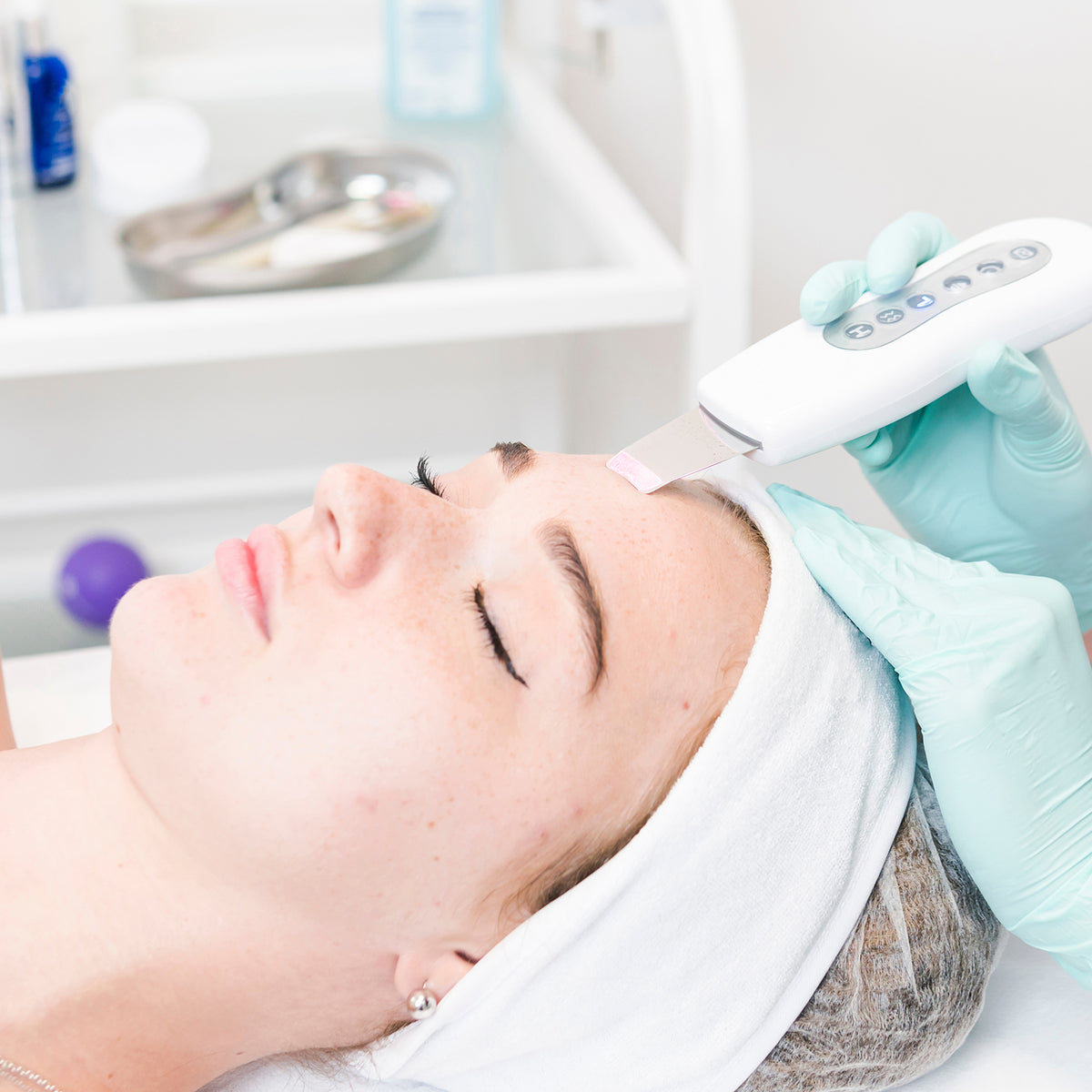
Another great way to cleanse the skin is by mode of ultrasonic exfoliation. An ultrasonic skin spatula or ultrasonic skin scrubber is a small hand-held device that features a thin plate that vibrates 28,000-30,000 Hz per second, and removes dead skin cells, dirt, and debris. The spatula works by creating high speed oscillations that extract pores without pain. For those clients with sensitive skin, ultrasonic exfoliation is a wonderful alternative to skin-cleansing brushes and microdermabrasion (both of which spread bacteria and aggravate redness and discomfort). The esthetician controls the pressure, angle and direction of the spatula to delicately work debris from the clients’ pores, focusing on problem areas and exfoliating the skin gently without aggressively brushing or peeling it. Since you are using water or a hydrating toner with the spatula, and not a gritty scrub, your clients’ skin will feel very clean and smooth after the treatment.
High Frequency
In addition to these devices, another basic tool we are all familiar with is the high frequency machine. The high frequency machine is used after extractions on clean skin, or over gauze to close the pores and kill germs and bacteria. High-frequency treatment uses low-current high-frequency alternating currents, delivered via a glass electrode.
Because the high frequency current converts some of the oxygen in the air into ozone, the treatment has a germicidal action, and is also drying and warming. Consequently, the treatment is used to aid healing and also to help desquamation and stimulate sweat and sebaceous glands. At up to 250,000 Hz frequency, the hollow glass electrode behaves like a glow discharge tube. When applied to the surface of the skin or scalp, a mild high frequency current passes through the neon or argon gas filled glass electrode causing it to light up with a neon orange or argon purple glow.
Cleanse the skin first, exfoliate, and perform extractions. Then, after the extractions have been performed, treat blemished area by lightly whisking the glass bulb tip of your high frequency wand across the surface of the client’s skin using circular motions. Concentrate on larger blemishes and the areas most affected for at least 30-40 seconds. The total treatment time with a high frequency machine is 3-5 minutes, and treatments can be repeated every other day. Similarly to the galvanic machine, the contraindications for this device are: pregnancy, metal implants/pins in the face or body, epilepsy, pacemaker, high blood pressure.
LED
To kill acne-causing bacteria, and reduce inflammation, one of the best modalities is LED – light emitting diode - a tiny computer chip encased in glass. Blue LED therapy for acne is non-invasive, painless and requires no recovery time. It is safe for all skin types and tones, and requires only 5 -15 minutes. The best combination of lights for acne is blue and red together – the blue kills germs and bacteria that cause acne, and the red renews the skin, and encourages new collagen production. Such lights are available for home use in a handheld, as well as panels for faster and more convenient treatment room services.
Far Infrared Sauna
Far infrared is another light that is beneficial for acne. This modality can be combined with heat for the best results, such as the case with infrared sauna therapy. Whole-body hyperthermia treatment causes the excretion of sweat from the sebaceous glands of the body, where these harmful materials are stored. Sweat is not excreted from the sebaceous glands using a normal sauna. Far infrared waves refer to the part of the spectrum of light that can heat objects directly, without having to heat the air or create steam. This is what differentiates far infrared saunas from ”regular” saunas that must heat the air between the heating device and a person. Regular saunas primarily heat up the surface of the skin whereas infrared rays can penetrate 1 to1.5 inches reaching the subcutaneous fat layer of the body.
Carbon heaters emit far infrared rays which match the body's own wavelength, which is essential to improving blood circulation and the health of internal organs in the body. In the lying position, the hyperthermic chamber treatment does not lower oxygen levels in the blood or increase lactic acid.
Sweating therapy with carbon heat allows the body to produce a much more perspiration through the pores, and sweating therapy is excellent for overall purification and balancing. The skin is the largest eliminative organ in the body, and the elimination through sweating is more passive and requires less expenditure of energy than elimination via the kidneys and bowels, and this is vital for destruction of acne-causing viruses and bacteria.
Traditional Chinese Medicine (TCM)
Of course, different systems work for different people, and no one’s acne is exactly the same. I, personally, am a big believer in Eastern medicine, and visit my acupuncturist weekly. Traditional Chinese Medicine (TCM), or Zhōngyī, is a healing system of Eastern medicine developed in China more than 2,000 years ago, incorporating therapies that are in some cases millennia older. What are the key differences between Western and Eastern medicine? Allopathic or Western medicine relies on the belief that disease is a defect within the human body or a destructive process caused by a specific outside pathogen. There are three main components of treatment available within Western medicine: pharmaceuticals, surgery and therapy.
Chinese Medicine views the body and the person, as a unified whole. Spiritual, mental, emotional and physical aspects are all seen as interconnected and interdependent. This perhaps explains why some people see Chinese Medicine as a "holistic therapy". TCM looks at multiple symptoms and their pattern of illness specific to the individual and delineates their cause from a combination of negative imbalances within the lifestyle, psyche, and effects of environmental stress, trauma or invasion by external pathogens. TCM utilizes a holistic approach to medicine and does not try to find one exact reason for illness; instead, it acknowledges that there are several factors that contribute to problems arising in the body. There are five main components of treatment available within TCM: acupuncture, Chinese herbal medicine, tui na bodywork, Tai Qi /Qi Gong (movement and stretching exercises), and nutrition.
According to TCM, one person’s acne is different from another’s, and therefore, each patient needs to be treated by attending to his or her unique symptoms. To achieve this, the acupuncturist must try to determine the acne’s root cause in order to bring balance to the body. The acupuncturist will determine the type of acne present—heat, damp, toxicity, stagnation, or a combination of them—by examining the location of the outbreak, the degree of inflammation, the overall appearance of the skin, and the health of the entire body.
The tongue and pulse reflect the nature of the imbalance causing the acne – a red tongue body with thick yellow coating is reflective of heat, but a pale tongue with a thick white coat is damp.
Acupuncture
In Chinese medicine, dampness and heat are the main causes of comedonal acne, and heat is a significant cause of inflammatory acne. Heat imbalances are reflected in red skin tone, as well as red inflamed papules and pustules. Acupuncture points on the arms will often be combined with facial acupuncture for inflammatory acne. Acupuncture close to the acne, traditionally called “ouch points”, is used for inflammatory type acne, combined with Chinese herbal medicine.
Cystic acne, the severely inflamed type of acne lays deep in the skin, and can be related to toxins and stagnation. Acupuncture close to the acne is often used for cystic acne. In addition, acupuncture points on the arms are used to clear heat, and on the spleen meridian to remove dampness.
Cupping
Cupping, a favorite of mine, is also effective for cystic acne. In TCM acne is often caused by heat, dampness, and stagnation, and cupping is effective at reducing heat and moving stagnation. Cupping is performed by depressurizing the inside of the cup with a flame or a vacuum, so it then lifts up the skin below it. Traditionally cupping works to increase circulation and remove heat from the body, and is used for a wide range of conditions including stress, muscle pain, arthritis, chest colds and fevers, and even some skin conditions.
Plastic and glass are the most common materials used today. Cupping therapy types can be classified into four main categories.
- Technical Types
- Dry
- Wet
- Massage
- Flash Cupping
- Power of Suction
- Light
- Medium
- Strong
- Method of Suction
- Fire
- Manual Suction
- Electrical suction
- Materials Inside Cups
- Herbal
- Water
- Ozone
- Needle
- Magnetic cupping
Cups may range in size from 1 to 3 inches in diameter.
Dry cupping commonly involves creating a small area of low air pressure next to the skin. The low air pressure required may be created by heating the cup or the air inside it with an open flame or a bath in hot scented oils, then placing it against the skin. As the air inside the cup cools, it contracts and draws the skin slightly inside. More recently, vacuum is created with a mechanical suction pump acting through a valve located at the top of the cup.
Fire cupping, my favorite, involves soaking a cotton ball in alcohol, then clamping it by a pair of forceps, setting it on fire and, in one motion, placing into the cup and quickly removing. Then, the cup is placed on the skin. Fire heats the inside of the cup and a small amount of suction is created by the air cooling down and contracting. Massage oil may be applied to create a better seal as well as allow the cups to glide over muscle groups in an act called "moving cupping". Immediately after, dark circles will appear where the cups were placed because of rupture of the capillaries just under the skin.
Wet cupping, or Hijama, is performed by letting the area under the cup fill with “bad” dark blood. The cups are applied to the skin using the fire or suction method, and left to cling to the skin for a few minutes, then it is lifted off and several very small incisions are made in the skin. The cup is then put back as it was before until the flow of blood subsides. Hijama is considered a form of energy medicine because it has been claimed to "unclog" purported meridians in the body.
When treating inflammatory conditions, such as acne, the goal is to remove heat and toxins. This is generally done through cupping on the back, even if the acne is on the face or chest.
There are a number of small studies and reports for cupping alone or in combination with other therapies that have been successful for treating acne, particularly for inflammatory and cystic acne. In TCM, it is very common to combine cupping with other modalities such as acupuncture or herbal medicine.
A meta-analysis of cupping concluded that cupping alone or in combination with herbal interventions is more effective than herbal interventions alone, and cupping combined with acupuncture was found to have a trend toward being more effective than acupuncture alone. A study that examined cupping found that 10 out of 11 people with acne had improvement in their symptoms. In these patients, cupping also reduced inflammatory chemicals circulating in the blood.
Electroacupuncture
Hormonal acne is also treated by TCM, since many women find that their acne flares up in the premenstrual part of the menstrual cycle. This type of acne is often a combination of whiteheads and blackheads with some inflammation involved, and tends to occur more commonly along the jawline. In Chinese medicine, hormonal acne is often related to stagnation, a lack of circulation in the body, and accumulation of dampness. In TCM, stress leads to stagnation of qi and blood, which is a common cause of hormonal acne.
Electroacupuncture, a technique that uses a small amount of electric stimulation at specific acupuncture points, has been shown to regulate hormones and reduce acne in women with PCOS (polycystic ovarian syndrome).Electroacupuncture for hormonal regulation is often done on acupuncture points such as located on the abdomen.
As with any condition, no two people are the same, and a method that may work well for one patient, may not work for another. These are merely devices that assist you in the treatment process – don’t forget that it’s your responsibility as a professional to select the best professional products, as well as a homecare routine for your acne client. Working in synergy – products, modalities, professional treatments, home care, diet, and a positive attitude will surely get your client on the way to a clear complexion.


